Is Titan Army a Good Monitor Brand? An Honest Look at the Value
Table of contents
For the hardware, yes. Titan Army sells specifications that mainstream brands charge substantially more for, particularly Mini LED backlights with dimming zone counts you normally find on displays costing two or three times as much. What you give up is not panel quality so much as everything that happens after the sale: the warranty runs a year rather than three, and support depends on where you bought it. Buy through a channel with a strong returns policy and the risk is manageable. Here is the detail.
Who Titan Army is
The brand belongs to Shenzhen Century Joint Innovation Technology Co., Ltd., which launched Titan Army in 2014. The company set up a production centre in Beihai in 2015 and had scaled that factory to around a million displays a year by 2016. It makes monitors, televisions and all-in-one systems, and it is the same parent company behind INNOCN, a name Western buyers are more likely to recognise.
That matters because it puts Titan Army in a different category from the thin shell brands that appear and vanish on Amazon. This is a manufacturer with its own production, not a label applied to somebody else’s finished stock.
Distribution has broadened steadily. The brand was an AliExpress import for years, arrived on Amazon in the US in late 2023, and now sells through Amazon, Newegg, European resellers and its own site.
What the hardware actually is
The pattern is specifications from a segment above the price, and the Mini LED models are where that shows most clearly.
| Model | Specification | Rough price |
|---|---|---|
| P2510S Plus | 24.5 inch 1440p, 240Hz Fast IPS, HDR500 | Around $250 |
| P2712V | 27 inch 4K 160Hz Fast IPS, dual mode 1080p at 320Hz | Around $280 |
| P275MV Plus | 27 inch 4K Mini LED, 1152 zones, HDR1000, dual mode | Around $400 to $470 |
| P326MV Max | 32 inch 4K 160Hz, 2304-zone Mini LED, DisplayHDR 1000 | Varies by region |
| M27E6V-PRO | 27 inch 4K 160Hz, 5088 dimming zones | Varies by region |
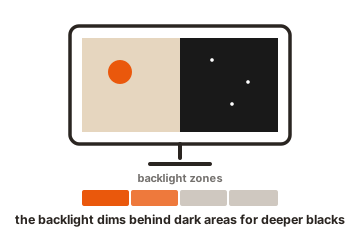
Dimming zone count is the number to watch. A 2304-zone panel controls its backlight in far finer detail than the 300 to 500 zones common on mainstream Mini LED monitors, which means less blooming around bright objects on dark backgrounds. Displays with counts in that range from the established brands sit at a much higher price. The dual-mode panels are the other unusual feature, switching between 4K at 160Hz and 1080p at around 320Hz for competitive play.
Where the value actually comes from
It is worth understanding why the prices are what they are, because the answer is structural rather than suspicious.
The parent company manufactures displays itself rather than commissioning them, and panels come from the same suppliers that feed the mainstream brands. Selling largely direct and online removes distributor margin, retail markup and much of the marketing spend that sits inside a familiar badge. On top of that, the Chinese domestic market is fiercely competitive on Mini LED specifically, which pushes zone counts up and prices down faster than in Western retail.
None of that is a shortcut through quality control. It is a different cost structure, and it is why the specification sheet reads the way it does.
The warranty is the weak point
This is the number that separates Titan Army from an established brand, and it is easy to check.
Titan Army’s warranty policy gives one year of cover against defects in materials and workmanship on products ordered from its own site, alongside a 14-day return window. Most established monitor brands run three years as standard, and several offer advance replacement within that period.
There is a second detail that catches people out. Titan Army’s return process applies only to orders placed on its own website. Buy through Amazon, AliExpress, Geekbuying or another reseller and returns go through that seller instead. The channel you choose therefore matters more here than it does with a brand that operates its own service network worldwide.
There is a practical dimension to this as well. Return shipping on a 32 inch monitor runs to real money once you are outside a retailer’s free-returns window, and it usually falls on the buyer. On a display that saved you a couple of hundred pounds or dollars, one paid return can erase a meaningful slice of that saving, which is another reason the first week matters more than the warranty document.
What the specification sheet does not tell you
The gap between budget and mainstream brands usually shows up in software rather than hardware.
On-screen menus tend to be less polished, with settings buried in odd places and joystick behaviour that takes getting used to. Firmware updates after launch are uncommon, so whatever the monitor does on day one is broadly what it will always do. You also do not get the desktop utilities the big brands bundle, meaning no software control of the on-screen display and no hardware calibration workflow.
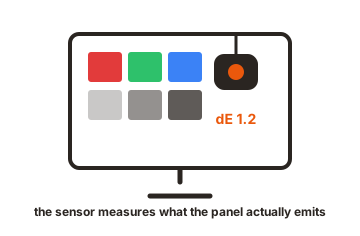
None of that affects image quality, and none of it is a reason to avoid the brand. It is simply where the money went, and it is worth knowing before the box arrives.
How to buy one sensibly
The brand rewards a slightly more deliberate approach than a familiar name does.
-
Buy where returns are strong
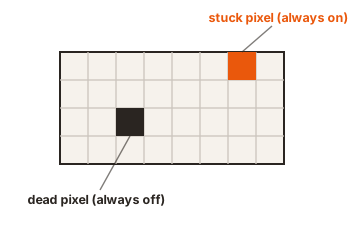
This is the single most useful protection. Newegg, for example, publishes a dead pixel return policy that accepts display returns with as little as one dead pixel inside the return period, which is stricter than most manufacturer warranties will ever be. -
Test properly in the first week
Full-screen white, black and solid colours for dead pixels, a dark room for backlight blooming and uniformity, and a run through the on-screen menu to check it behaves. -
Test properly in the first week
Full-screen white, black and solid colours for dead pixels, a dark room for backlight blooming and uniformity, and a run through the on-screen menu to check it behaves. -
Look for measurements on the exact model
Several Titan Army displays have been through independent test benches, which is unusual at this price and worth taking advantage of before you commit to a higher-end Mini LED unit. -
Check certifications rather than adjectives
DisplayHDR and VESA Adaptive-Sync badges are tested by approved labs. Phrases like “HDR ready” are not. - Keep the packaging until you are past the return window, because shipping a 32 inch monitor back without its original box is not realistic.
Who it suits, and who it does not
Titan Army makes sense if you want a specification the mainstream brands are not offering at your budget, particularly Mini LED contrast or a dual-mode high refresh panel, and you are comfortable handling a return yourself if the first unit is not right. For a home setup where the display is important but not load-bearing, that is a reasonable trade for the money saved.
It is a weaker fit if you need a display for paid work where downtime costs you, where a three-year warranty and an advance replacement service are part of what you are buying. It also suits you less if you would rather not think about any of this, in which case paying more for a familiar badge is buying convenience, and convenience is a legitimate thing to buy.
Conclusion
Titan Army is a real manufacturer with real engineering, not a badge on generic stock, and the hardware genuinely competes above its price. The gap against established brands is in the warranty and the support path rather than in the panels. Treat it accordingly: buy through a retailer with a generous return policy, test the monitor thoroughly in the first week, check the specific model has been measured somewhere independent, and understand that after year one you are on your own. On those terms it is one of the better value propositions in monitors.
For more, see our monitor buying guides.
Frequently asked questions
Where are Titan Army monitors made?
In China, by Shenzhen Century Joint Innovation Technology Co., Ltd., which has manufactured displays under the Titan Army name since 2014 and also owns INNOCN.
How long is the Titan Army warranty?
One year on products bought from the company's own site, with a 14-day return window. Orders placed through Amazon or other resellers are handled under that seller's policy instead.
Are Titan Army Mini LED monitors any good?
The zone counts are the standout, with models running from 1152 up to 5088 dimming zones at prices where mainstream brands offer a few hundred. High zone counts mean less blooming, which is the main weakness of Mini LED.
Is Titan Army the same as INNOCN?
They are separate brands with the same parent company, Shenzhen Century Joint Innovation Technology. Some models are closely related, though the ranges and pricing differ.
Should I buy Titan Army or a mainstream brand?
Buy Titan Army for specification per dollar if you can handle a return yourself. Buy a mainstream brand if you want three years of cover and a service route, and treat the price difference as what that convenience costs.