Why Is OLED Monitor So Expensive? The Real Reasons
Table of contents
An OLED monitor costs more because only two companies in the world make the panels, those panels are hard to build at the high pixel density a monitor needs, and a large share of every production batch fails and gets thrown away. Add newer panel designs that push cost even higher, and you get a screen that can run three or four times the price of a normal LCD.
If you have been staring at a $500 monitor wondering why the same size LCD sells for $180, this breaks down exactly where that money goes, and whether the price is worth paying.
The short answer: where your money actually goes
The price comes down to a few real costs stacked on top of each other. There is no single villain. It is supply, difficulty, and waste working together.
- A tiny number of suppliers, so there is little price competition.
- Low yield, meaning many finished panels get scrapped.
- High pixel density, which is harder to build than a big TV screen.
- Expensive, sensitive materials and precise factory equipment.
- Newer panel designs that add layers and cost.
Each of these is worth understanding on its own, because they explain why prices are falling slowly instead of crashing the way older tech usually does.
Only two companies make the panels
Almost every OLED monitor you can buy uses a panel from one of two makers: Samsung Display, which builds QD-OLED, or LG Display, which builds WOLED. Nearly every brand you know, from ASUS to MSI to Dell, buys panels from these two and puts them in their own cases.
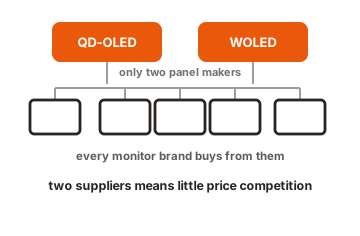
When only two suppliers control a market, prices stay high. There is no third or fourth factory undercutting them to win orders. That is starting to change, as Chinese maker BOE weighs a move into OLED monitor panels, but for now the two-supplier setup keeps a floor under the price.
A monitor brand can only sell you an OLED as cheaply as it can buy the panel. With two suppliers, that panel is never cheap.
Why so many panels fail to pass
Yield is the share of good panels that come out of a production run. LCD makers have refined their process over decades, so their yield is very high and waste is low. OLED is younger and far less forgiving.
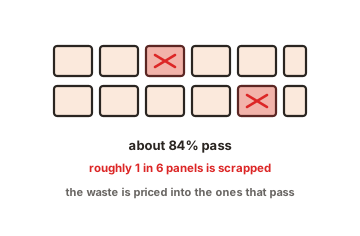
Building an OLED panel means laying down ultra-thin layers of organic material with near-perfect precision. Those layers are extremely sensitive to dust, moisture, and tiny defects. One flaw during production can ruin the whole panel. When a big chunk of a batch gets scrapped, the cost of those failures gets folded into the price of the good ones that survive.
The trend is moving the right way. Samsung’s QD-OLED yield rose from about 68 percent in 2022 to roughly 84 percent in 2023, which helped cut panel costs. But even at 84 percent, close to one in six panels still fails, and that waste is money you help pay for.
Monitors are harder to build than OLED TVs
Here is the part that surprises people: a 27-inch OLED monitor can be trickier to make than a 65-inch OLED TV, even though it uses far less material. The reason is pixel density.
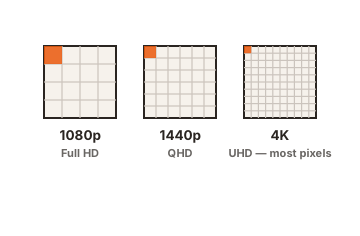
A TV spreads a 4K image across 55 or 65 inches, so its pixels are large and spaced out. A monitor packs similar or higher resolution into 27 or 32 inches, so the pixels have to be far smaller and packed much tighter. That tighter packing pushes factory tools to their limits, and the closer they sit, the more panels fail. You can read a deeper technical breakdown at TFTCentral’s OLED monitor article, which walks through why higher density makes these panels so hard to produce.
This is also why small OLED monitors stayed rare for so long. The size that sells best for a desk is one of the hardest to make well, so the price never had much room to drop.
Newer panel designs push the cost back up
Just as one generation of panels gets cheaper, the makers launch a harder, better one. Both suppliers have moved to what is called a tandem or multi-stack design, which stacks extra light-emitting layers to boost brightness and lifespan.
Samsung calls its latest version QD-OLED Penta Tandem, a five-layer stack that the company says delivers about 30 percent better efficiency and roughly twice the lifespan of the older design. LG has its own Primary RGB Tandem WOLED. More layers means a more complex build, so the newest and best panels always carry a premium. Every time the tech gets better, the top of the price range resets higher.
There is a bright side. These upgrades also fix real weaknesses. The newer panels get brighter, last longer, and resist burn-in better than early OLED screens, so the money is buying genuine improvement, not just a spec-sheet number.
OLED vs LCD: what the extra money buys
It helps to see the two side by side. The table below shows where the cost difference comes from and what you get in return.
| What you're paying for | OLED monitor | Regular LCD monitor |
|---|---|---|
| Who makes the panel | Two suppliers worldwide | Dozens of factories |
| Panel yield | Lower, more waste | Very high, refined for decades |
| Pixel density | High, harder to build | Easy to hit |
| Contrast / black levels | Perfect, self-lit pixels | Limited by backlight |
| Response time | Near-instant | Slower, some blur |
| Typical 27" price (2026) | $400 to $900 | $150 to $350 |
The gap in the last row tells the story. Two suppliers, lower yield, and harder-to-build panels all push OLED into a price bracket that mass-produced LCD left behind years ago. What you get back is a picture that LCD cannot match: pixels that turn fully off for perfect black, and response times fast enough to cut almost all motion blur in games.
Are OLED monitors getting cheaper?
Yes, slowly. Panel costs have fallen as yields improve and factories run at higher volume. The OLED monitor market grew around 78 percent year over year in early 2026, and more volume usually means lower prices over time.
You can already see it at the shelf. A serious 27-inch QD-OLED monitor that would have cost well over $700 a couple of years ago has dropped toward $400 in 2026. Most current QD-OLED and WOLED monitors now land in a $400 to $800 range, which was unthinkable when the first models arrived.
Do not expect an overnight collapse, though. When a panel gets cheaper to build, the maker often keeps the extra margin for a while to pay back the huge cost of new factory lines. Savings reach shoppers gradually, not all at once.
Is an OLED monitor worth the price for you?
That depends on how you use your screen. OLED is not automatically the right pick just because it costs more.
It is worth it if you mostly game or watch video and you care about picture quality. The perfect blacks, rich color, and fast response are a real, visible upgrade, especially for HDR content in a dark or dim room.
Think harder if your screen shows the same thing for hours: a fixed taskbar, coding windows, spreadsheets, or a news ticker. Static bright elements left on screen for long stretches are the main cause of burn-in, where a faint ghost of the image sticks around. Modern monitors fight this with pixel shifting and logo dimming, and you can help by using dark themes and hiding the taskbar, but heavy all-day desktop use still leans toward LCD.
A common middle path is one OLED for games and media plus a cheaper LCD for everyday work. If you want to see how the two panel types stack up before you spend, Samsung’s QD-OLED panel overview and the many current models from ASUS, MSI, LG, and Dell give you a sense of what each price tier delivers.
Conclusion
An OLED monitor is expensive because only two companies make the panels, those panels are hard to build at high pixel density, and many fail in production, with newer multi-layer designs keeping the top end high. Prices are slowly falling as yields improve and volume grows. If you game or watch video and want the best picture, the cost is easy to justify. For all-day static desktop work, a good LCD is still the smarter buy.
Already own one? See our MSI QD-OLED colour settings guide, or browse all our monitor buying guides.
Frequently asked questions
Why is a 27-inch OLED monitor more expensive than a 65-inch OLED TV?
Because a monitor packs pixels far tighter. A TV spreads 4K across a big screen with large pixels, while a monitor squeezes similar resolution into 27 inches. That density is harder to build and more panels fail, so cost per inch is higher.
Will OLED monitors ever cost the same as LCDs?
Not soon. Prices are dropping as yields and volume improve, but with only two panel suppliers and a harder build, OLED stays a premium product. Expect it to get closer to LCD over time, not equal.
Is QD-OLED or WOLED more expensive?
Price depends more on size, refresh rate, and generation than on the panel type itself. Both Samsung's QD-OLED and LG's WOLED sit in the same $400 to $900 band for common 27-inch and 32-inch models.
Does the high price mean OLED monitors last longer?
Not exactly. You pay for picture quality and speed, not extra lifespan. OLED pixels slowly dim with use and can suffer burn-in from static images, though newer tandem panels last noticeably longer than early models.
Are cheap OLED monitors worth buying?
Yes, if the price drop comes from an older generation or smaller size, not a defect. A $400 QD-OLED from a known brand offers a huge picture upgrade over LCD. Just check the panel generation and warranty before buying.