Should I Use Isolation Pads on Monitor Stands? A Straight Answer
Table of contents
Yes, in most setups you should. Even a solid stand still lets your speakers pump vibration into the metal, and a pad breaks that link so your low end gets tighter and easier to trust. There are a few cases where you can skip them, and this guide walks through exactly when pads help, when they don’t, and how to set them up right.
If you just bought a pair of stands and you’re wondering whether to spend another £20 to £40 on pads, the short version is that pads are cheap insurance for accurate sound. The longer version depends on your stand, your speakers, and your floor. Let’s go through it.
This question comes up a lot because monitor stands feel like a finished solution. You’ve already lifted the speakers off the desk, put them at ear height, and moved them away from the wall. It’s fair to ask whether a foam pad on top is really doing anything, or whether it’s a small upsell that gets recommended out of habit. The honest answer sits in the middle: pads solve a real problem, but the size of that problem changes with your setup.
What isolation pads actually do
An isolation pad is a block of dense foam (or rubber, or a small sprung platform) that sits between your speaker and whatever it rests on. Its job is decoupling: keeping the speaker’s vibrations from spreading into the surface below.
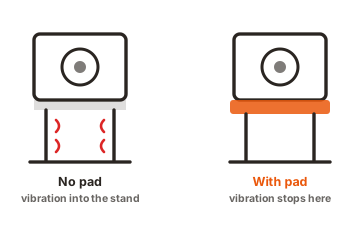
Low frequencies are the worst offenders because they carry the most energy and move the cabinet the most. A tweeter playing a high note barely shakes anything, but a woofer pushing a deep bass note moves a lot of air and rocks the whole box. That movement is what leaks into the stand and the desk. So the resonance you pick up is almost always in the low end, which is the hardest part of a mix to get right in the first place.
Here’s the problem it solves. A studio monitor is a box that vibrates when it plays. If that box sits hard against a stand or desk, the vibration passes straight into it. The surface then acts like a second, sloppy speaker, adding its own resonance to what you hear. That resonance is loudest in the bass.
Think of a pad like the shock absorbers on a car. You don’t want to feel every bump in the road, and you don’t want to hear every buzz and rumble the surface adds on top of your mix.
The result of skipping isolation is a low end that sounds bigger than it really is. You get false bass that isn’t in the file. So you turn the bass down in your mix to compensate, and then it sounds thin everywhere else. A pad cuts that added resonance so the bass you hear is closer to the bass that’s actually there.
It shows up in a few ways you can learn to spot. Kick drums and bass lines sound thick and one-note, like every low note has the same weight. Small movements of the speaker change the sound more than they should. And a mix that felt full in your room turns out weak and bass-shy when you play it in the car or on headphones. That gap between your room and the real world is exactly what accurate monitoring is meant to close, and stray surface resonance widens it.
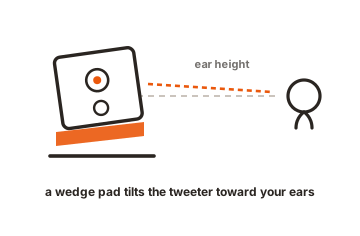
Most decent pads also let you tilt the speaker. The popular Auralex MoPAD, for example, ships with wedge adjusters that set the monitor flat or at plus or minus four and eight degrees, which helps when a stand puts the tweeter above or below ear height. You can check the angle and weight specs on the Auralex MoPAD product page.
Do stands already isolate your monitors?
Partly, and this is the heart of the question. Many monitor stands come with a thin layer of foam or rubber on the top plate. That built-in layer does some decoupling, so a stand is already a step up from setting a monitor straight onto a wooden desk.
But two things are worth knowing. First, that built-in pad is usually thin, and a few millimetres of firm rubber does less than a proper foam block. Second, the stand itself is a hollow metal structure that can resonate. A steel pillar has its own ring to it, and a speaker bolted-tight against the top plate can excite that ring at certain frequencies.
So a stand reduces the problem compared with a bare desk, but it doesn’t fully solve it. A dedicated pad on top of the stand goes further, and it also lets you tilt the speaker toward your ears, which a fixed top plate can’t do.
When pads on a stand are worth it
For most home studios, adding pads is the safe call. Here are the situations where they clearly earn their place:
- Your stand has only a thin rubber strip, or nothing, on the top plate. A real foam pad decouples more.
- You hear a boomy, uneven low end and you’re not sure what the bass is really doing. Extra resonance is a common cause.
- The tweeter sits above or below your ear line. A tilting pad aims the sound at you and improves clarity in the highs and mids.
- You’re mixing or mastering. Accuracy matters most here, and false bass leads to mixes that fall apart on other speakers.
- Your stands are lightweight or feel slightly hollow when you tap them. Lighter metal rings more, so a pad helps more.
None of this needs to be expensive. A basic foam pad runs about the price of a couple of coffees, and the change is easy to hear on bass-heavy material. That’s a good trade for the money.
How big is the change? On a resonant setup it’s obvious: the bass tightens, the mix gets easier to read, and the speaker feels like it’s floating rather than shaking the furniture. On a setup that was already fairly well isolated, the change is subtle and you might have to listen for it. Either way, the pad can’t make things worse, so the downside risk is basically zero. That’s what makes it an easy first upgrade.
When you can skip them
Pads aren’t a law. There are real cases where you won’t gain much:
- Your stand already has thick, purpose-made decoupling built into the top plate. Some higher-end stands do, and stacking more foam on top adds little.
- You’ve filled a hollow stand with sand or shot and bolted it down hard. That’s the coupling approach (more on that next), and it’s a valid alternative, not a mistake.
- You’re using small speakers at low volume for casual listening, not mixing. The added resonance is real but may not bother you.
- You’ve already got proper isolation stands, like sprung IsoAcoustics-style platforms, under the speakers. Doubling up gains nothing.
If you try that test and feel almost nothing, and your low end already sounds even, you can save the money and move on to treating your room, which usually matters more than pads anyway.
Does the floor under your stand matter?
Yes, and it’s easy to forget. The stand’s feet sit on your floor, and the floor is part of the same vibration path. A suspended wooden floor, common in older homes and upper storeys, flexes and resonates far more than a concrete slab. On a bouncy wooden floor, the whole stand can rock slightly and feed low-frequency energy back into the room.
If that’s your situation, isolation matters in two places: under the speaker and under the stand’s feet. Small rubber feet or pads beneath the stand help stop the floor and stand from trading vibration. Pads under the speaker and pads under the feet target different parts of the path, so on a lively floor it’s reasonable to use both. On a solid concrete floor the feet matter less, and a pad under the speaker usually does the job on its own.
Pads vs coupling: the other school of thought
There are two ways to deal with speaker vibration, and they pull in opposite directions.
Decoupling is what pads do. You float the speaker on something soft so its vibration can’t travel into the surface. This is the easy, cheap, popular route for home setups.
Coupling is the reverse. You lock the speaker firmly to a very heavy, solid mass, so heavy that the speaker can’t move it. Filling a hollow stand with sand and using spikes into a solid floor is the classic version. The idea is that if the stand is massive enough, the tiny vibrations have nowhere to go.
Both can work. Coupling needs real mass and a solid floor to be effective, which is why it’s more common in purpose-built rooms. For a typical home studio on a wooden or carpeted floor, decoupling with pads is simpler and more forgiving, and it’s the reason pads are the default advice. You don’t need both. Pick the one that fits your gear and room.
How to set pads up on a stand
Getting the most from a pad takes about five minutes. Here’s the order that works:
-
Clean the top plate
Wipe off dust so the pad grips and sits flat. -
Check the pad size against your speaker's base
The pad should sit fully under the cabinet, not hang off the edges. Big speakers may need the larger version. -
Set the tilt
If your pad has wedge pieces, decide whether the tweeter needs to aim up or down to reach your ears, then place the wedge to match. Keep it flat if the tweeter is already at ear height. -
Centre the speaker on the pad
Line up the cabinet so its weight sits evenly, or it can lean over time. -
Match both sides
Set the left and right speakers to the same angle and position so your stereo image stays balanced. -
Recheck ear height
With the speaker on the pad, the tweeter should sit at roughly the height of your ears when you’re seated. Adjust the stand or tilt if it’s off.
Common mistakes to avoid
A few small errors undo the benefit. Using a pad that’s too small lets part of the cabinet overhang and rock, so the isolation is uneven. Setting different tilt angles on the left and right speakers skews your stereo image, which quietly ruins panning decisions. And placing a speaker off-centre on the pad puts uneven pressure on the foam, so over months it compresses on one side and the monitor starts to lean.
Take a minute to line both speakers up the same way and check them by eye from your seat. Symmetry between left and right is one of the most valuable and most overlooked parts of a good listening position.
What to buy
You don’t need anything fancy. The main choice is foam pads versus a small sprung isolation platform.
| Option | Best for | Notes |
|---|---|---|
| Foam isolation pads | Most home studios | Cheap, effective, often tiltable. The common starting point. |
| Sprung isolation platforms | Heavier monitors, more decoupling | Costlier, very stable, little to no tilt. |
| Rubber hemispheres / sorbothane | Budget or DIY setups | Small, low-cost, no tilt, works surprisingly well. |
Foam pads are the sensible default for a first pair. They’re cheap, they decouple well, and the tiltable ones fix ear-height problems that a rigid stand plate can’t. Their one weakness is that very heavy monitors can slowly crush cheap foam flat, at which point it stops isolating. If you run big, heavy speakers, either buy a pad rated for the weight or step up to a sprung platform designed to hold its shape under load.
Whatever you pick, size it to your speaker’s weight and footprint. A pad rated for a light bookshelf monitor may squash flat under a big three-way. Foam pads that hold up to around 45 kilograms cover most home monitors with room to spare. Check the cabinet’s weight in its manual and give yourself margin rather than buying right at the limit.
Spend the bigger money on your room before you chase premium pads. Bass traps and a bit of treatment on the first reflection points change what you hear far more than the difference between a cheap pad and an expensive one.
Conclusion
For most home studios the answer is yes: put a pad between your monitor and the stand. A stand’s thin built-in layer helps a little, but a proper pad decouples the speaker better, cuts false bass, and often lets you tilt the tweeter to your ears. Skip pads only if your stand already has real isolation, you’ve deliberately gone the heavy coupling route, or a quick hand test shows almost no buzz. Fit them, level both sides, and trust your low end.
For more on getting screens and gear positioned properly, browse our monitor mounting guides.
Frequently asked questions
Do monitor stands need isolation pads if they already have foam on top?
Usually still yes. The built-in layer is often thin and firm, so it decouples less than a purpose-made pad. Adding a foam pad goes further and lets you tilt the speaker toward your ears.
Will isolation pads reduce my bass?
They cut the false bass added by the surface resonating, not the real bass in your mix. Some low-end rumble drops away, but what remains is more accurate. That's the point of using them.
Are isolation pads or a heavy coupled stand better?
Both can work. Pads (decoupling) are cheaper and easier and suit most home rooms. Coupling, filling the stand with sand and spiking it to a solid floor, needs real mass. Pick one, not both.
Can I use isolation pads on the floor and on stands?
Yes. Pads under floor-standing speakers or under the stand's feet help on hard or resonant floors. You can pair floor isolation with pads under the speakers, since they target different vibration paths.
How much should I spend on isolation pads?
Not much. Basic foam pads cost about the price of a couple of coffees and handle most home monitors. Save bigger budgets for room treatment, which changes your sound more than premium pads do.